|
Theyyam - The Art Form of Kasargod
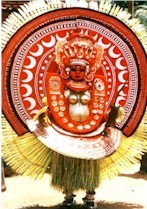 Theyyam or Theyyatom is one of the most outstanding and popular ritual art of northern Kerala particularly now found in the traditional Kolathunadu of the present Kannur and Kasargod District. As a living cult with century old traditions, rituals and customs, it embraces almost all castes and classes of Hindu religion. The term theyyam is a corrupt form of Dhaivam or God. It is a rare combination of dance and music and reflects important features of a tribal culture. Theyyam or Theyyatom is one of the most outstanding and popular ritual art of northern Kerala particularly now found in the traditional Kolathunadu of the present Kannur and Kasargod District. As a living cult with century old traditions, rituals and customs, it embraces almost all castes and classes of Hindu religion. The term theyyam is a corrupt form of Dhaivam or God. It is a rare combination of dance and music and reflects important features of a tribal culture.
The indigenous Theyyam cult under the influence of the great classical Indian tradition incorporated new ideals and legends. However its form and content did not change very much.
replique montre france
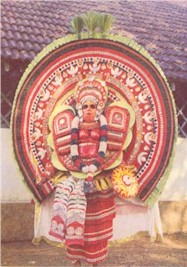 The popular folk religion based on Theyyam was influenced by the Brahmanical settlements in Kolathunadu like Payyannur and Taliparamba. According to Keralolpathi, a famous historical book, Parasu Rama sanctioned the festival like Kaliyattam to the people of Kerala. Kaliyattam means Theyyattam tag heuer replica or Daivattam, which lasts for 3 to 11 days. He assigned the responsibility of Theyyam dance to the indigenous communities like Panan, Velan, Vannan and Malayan. Velan one of the Theyyam dancers are referred to in the sangam literature. According to sangam traditions, he was employed by the mothers of love born girls to exercise the malignant spirits from their daughters. All rituals described in the sangam works and their commentaries are being observed by Velan and other dancing communities. The popular folk religion based on Theyyam was influenced by the Brahmanical settlements in Kolathunadu like Payyannur and Taliparamba. According to Keralolpathi, a famous historical book, Parasu Rama sanctioned the festival like Kaliyattam to the people of Kerala. Kaliyattam means Theyyattam tag heuer replica or Daivattam, which lasts for 3 to 11 days. He assigned the responsibility of Theyyam dance to the indigenous communities like Panan, Velan, Vannan and Malayan. Velan one of the Theyyam dancers are referred to in the sangam literature. According to sangam traditions, he was employed by the mothers of love born girls to exercise the malignant spirits from their daughters. All rituals described in the sangam works and their commentaries are being observed by Velan and other dancing communities.
Ezhimalai, described in the sangam literature, ruled by Udayan Venmon Nannan , is situated in Kolathunadu near Payyannur. Therefore the Tamil sangam culture with variations still continue in this region. The dance of Velan community had taken new forms and developed in to the present day cult of Theyyam over a period of 1500 years. This uninterrupted continuity of sangam traditions makes theyyam a prominent religious system of north Kerala. As a religious and social institution, it has significant place in the cultural history of the region. Under the impact of Aryans the cult of Theyyam had changed substantially incorporating new trends and sub cults along with its tribal character. In short it can be stated that all prominent characteristics of primitive tribal religious worship had widened the stream of Theyyam cult and made it a deep-rooted folk religion of the million. For instance, the cult of Mother Goddess had an important place in Theyyam. Besides the practice like spirit-worship, hero worship, masathi worship, tree worship, ancestor worship, animal worship, serpent-worship, worship of the Goddesses of disease and gramadevatha worship are included in the main stream of Theyyam cult. Under the influence of Aryan myths and legends, a large number of brahmanical Gods and Goddesses had infiltrated a separate cuts into Theyyam. Along with these Gods and Goddesses there exists innumerable folk Gods and Goddesses and most of these Goddesses are known as Bhagavathis as a matter of sanskritisation.
Different branches of Brahmanical religion such as Saktism, Vaishnavisam, and Saivism, now dominate the cult of Theyyam. However the forms of propitiation and other rituals are continuation of a historical part. Blood offering is forbidden in several cult centres under the influence of Buddhism,Jainism and Brahmanism. In such centres, separate places outside the outer wall of the shrines are selected for blood offering, preparing traditional (kalam)Kendra as Vadakkemvathil. The Theyyam deities propitiated through cock-sacrifice will not enter inside such shrine walls. On account of the later origin of Vaishnavism in Kerala, it has no vide-spread influence on Theyyam cult. Only a few deities are available under this category. The two major Theyyam deities of Vaishnavism are Vishnumoorthi and Daivathar. The legend of Vishnumoorthy identified the God's fake uhren kaufen migration from Managlore to Kolathunadu as Vishnavism was very popular in the Tuluva country during the 13th century. All other categories of Theyyam deities can be incorporated in Saivism and Saktism. Even ancestors, heroes, animals etc. are deified and included in those categories. In brief, the Theyyam provides a good example for the religious evolution and its different stages in Hinduism. When the cult of Theyyam, borrowed liberally from Brahaminism, the brahmins with their social and caste superiority also patronised the Theyyam Gods and Goddesses. They established their own Shrines and Kavus(Groves) for Theyyam deities where non-brahmanical rituals and customs are observed. The Goddesses like Raktheswari, Chamundi, Someshwari and Kurathi and Gods like Vishnumoorthy are propitiated in these house hold shrines. The rituals in such shrines are different from those of the Brahmanical temples Theyyam cult can be said as the religion of the masses. Even the follower of Islam are associated with the cult in its functional aspects. Same of the mappila characters like Ali Chamundi of Alichammundi Devasthan of Kumbla have found a place in the cult. |
|